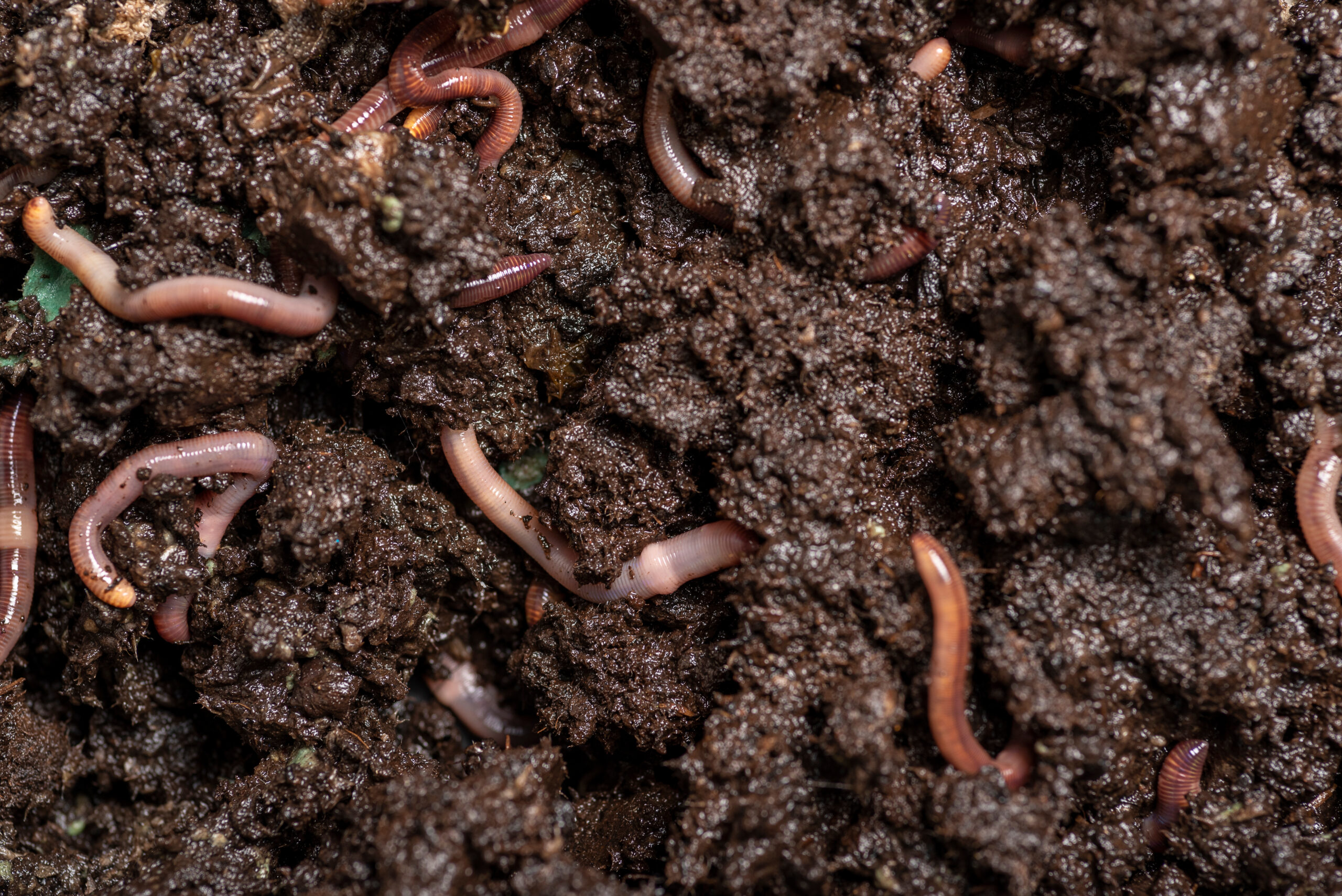
I’ve walked blocks where a grower spread compost every year for a decade and the organic matter number barely moved. Two tenths of a percent, maybe. He’d done the work, paid the freight, run the spreader, and the lab report looked almost the same as when he started. His question was fair: where did it all go?
Most of it went into the air.
Here’s the part that surprises people. When you pull a soil sample from a block that’s functioning well, the largest share of the stable carbon in it isn’t leftover plant residue. It isn’t the compost you applied. It’s dead microbes. Cell walls, membranes, the chemical wreckage of billions of organisms that lived, ate, and died in that soil. Soil scientists call it necromass. It binds to clay and silt surfaces, and once it does, it can sit there for centuries.
That’s been my position for years, based on what I’ve watched happen in the field. A study out of Kansas State put imaging behind it. Researchers took intact soil from a Kansas field and ran it through synchrotron X-ray facilities, which let them see where carbon actually sits without grinding the sample apart. In the plots that got manure and compost, they found more carbon tucked inside tiny protected pores and bonded to mineral surfaces than in the plots that got synthetic nitrogen or nothing. They also found more microbial carbon.
So compost worked there. It didn’t work in my grower’s block. Same material, opposite result, and the reason is in a detail that’s easy to skip past: that Kansas ground had not been tilled in 22 years.
Think about what that means. Two decades of undisturbed aggregates. Pore structure intact. Biology running without being torn apart every season. The compost went into a soil that was already working, and the organisms in it converted that material into their own bodies, generation after generation, until a share of it ended up bonded to mineral surfaces where it will stay for centuries.
The compost didn’t become the stable carbon. The compost fed the organisms that became the stable carbon. Whether that conversion happens at all depends entirely on what’s waiting for it when it hits the ground.
Think about the arithmetic. A microbe eats a carbon compound. Most of that carbon is respired off as CO2, because the organism has to breathe to live. A fraction gets built into its body. Then it dies, often within days, and some of what’s left of it finds a mineral surface and locks on. So carbon stabilization doesn’t happen in one pass. It happens through generation after generation of microbial life and death, with losses at every step.
Which means the question was never how much carbon you applied. It’s how many times that carbon can cycle through a living body before it escapes.
And that’s where soil function comes back into it. A compacted block with no oxygen in the top eight inches doesn’t run many generations. Neither does a block sitting under a bicarbonate load with the pH pushed up and the calcium tied off. In those conditions, you can apply all the carbon you want. You’re paying freight to release CO2 on a schedule.
Run that same material into a block where aggregation is intact, oxygen moves, and the biology is active, and far more of it ends up where you want it.
There’s a cheaper carbon source than anything on a truck, and it’s already standing in the field. A healthy plant pushes a significant share of what it fixes through photosynthesis straight out of its roots as exudate. Sugars, amino acids, organic acids, delivered continuously into the rhizosphere, free, with no spreader and no salt load. That’s the carbon that drives the microbial turnover that builds necromass. Compost is a one-time deposit. A working root zone is an annuity.
So when was the last time you looked at your carbon program as a biology question instead of a tonnage question?
The practical order is the same order we use for everything else. Get the soil functioning first, which means relieving compaction, cutting bicarbonates, displacing sodium, and getting air into the profile. Then activate the biology, so there’s something alive to process what arrives. Then bring in amendments as feedstock, knowing they’re raw material rather than the finished product.
Spread compost on a block that can’t breathe and you’ve bought an expensive way to make CO2. Spread it on a block that’s working and you’ve fed a system that will keep paying you back for decades after the spreader leaves.
The soil has to work before the plant can perform. Turns out the same is true for carbon.