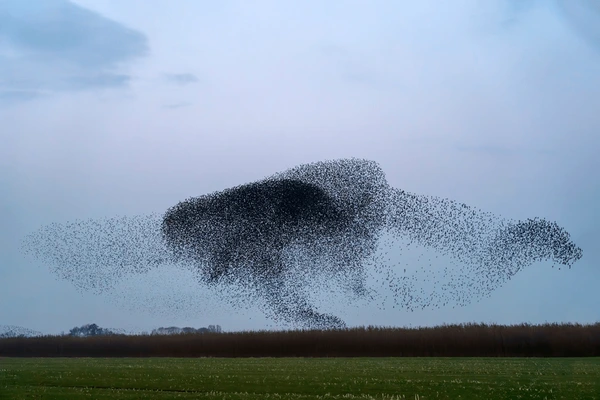
If you have watched a murmuration of starlings, you have seen something that should be impossible. Thousands of birds turning as one body, reversing direction in a fraction of a second. No leader. No signal going out to the flock.
Researchers who tracked individual birds found the rule that produces it. Each starling is not watching the flock. It is watching roughly its seven nearest neighbors, and nothing else. Seven local relationships, repeated thousands of times, and a shape emerges that no bird intended or could see.
The same principle is running underneath your crop beds, and it explains something most growers have experienced and written off.
Bacteria count
Soil microorganisms continuously release small signaling molecules. When the population is sparse, those molecules diffuse away and nothing happens. As the population grows, the concentration in the immediate neighborhood rises — and at a certain point it crosses a threshold, every cell in range registers it at once, and the community switches a set of genes on together.
Microbiologists call this quorum sensing. The organisms are effectively taking a headcount, waiting until there are enough of them for a coordinated action to be worth attempting.
The classic case is a marine bacterium living in the light organ of a squid. Diluted in seawater it does not glow. Packed into the light organ at high density, the whole population lights up at once. Same organism, same genes. The only variable is how many neighbors it has.
Why this matters in a strawberry bed
If soil biological function were linear, every increment of improvement would return a proportional benefit. Quorum sensing says otherwise. Below the density threshold, the community is present but silent. Enzyme release, nutrient solubilization, biofilm production, competitive defense against pathogens — these are collective behaviors that individual organisms do not perform alone. They are switched on by population density, not by the organism being there.
Which means you can add biology to a block, confirm the organisms arrived, and see no response at all. Not because the biology failed. Because it never reached the number where it starts doing anything.
That is the honest explanation for a complaint I hear constantly: “I tried biologicals once. Nothing happened.”
Often nothing did. A single application into depleted, compacted, salt-loaded ground is organisms arriving below threshold, in an environment that will not let them multiply. The grower concludes the product does not work. What actually happened is that the flock was too small to turn.
Why the order is the whole thing
Organisms introduced into compacted, oxygen-poor, salt-stressed ground will not multiply. This is why every program we build runs in the same sequence — Rebuild → Activate → Reinforce → Finish — and why the first two stages are not preliminaries to the interesting part.
Rebuild corrects soil function: structure, root-zone oxygen, salts, chemistry. Activate wakes the biology and raises the plant’s metabolic intensity. Only then do Reinforce and Finish have anything to work with.
Rebuild is what makes the threshold reachable. Activate is what gets the population across it. Skip past them to a product aimed at the plant, and the threshold is never crossed at all.
There is a harder consequence in that. With a linear input, partial effort returns partial results. With a threshold system, partial effort can return nothing — and then a modest additional increment returns a great deal. That is an argument for running a biological program properly for a full season, or not starting it.
The flock already knows how to turn. Most of what we do well is making sure enough birds show up.
Deac Jones | Founder, Andaman Ag Corporation 415.307.6690 | Deac@Andaman-Ag.com | www.Andaman-Ag.com Improving Agriculture from the Ground Up®